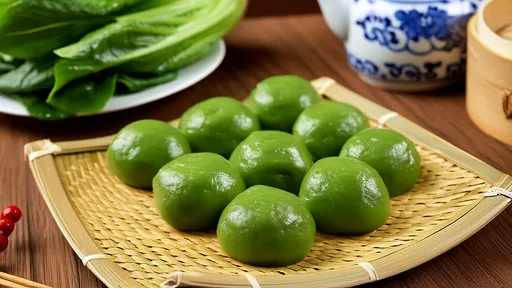
In the evolving landscape of traditional food preparation, a notable innovation has emerged from the realm of Chinese cuisine, specifically concerning the beloved Qingtuan, or green rice balls. These vibrant treats, traditionally made during the Qingming Festival, have long relied on mugwort for their distinctive green hue and earthy flavor. However, a recent shift has seen spinach juice stepping in as a modern alternative, promising not only a similarly vivid color but also addressing issues of sustainability and accessibility.
The traditional method of using mugwort, while culturally significant, presents several challenges. Mugwort's availability is seasonal, and its distinct, slightly bitter taste is not universally appealing. Moreover, the process of preparing mugwort—harvesting, cleaning, and grinding—is labor-intensive. Enter spinach, a common leafy green available year-round in most regions. Its juice, when extracted properly, offers a brilliant green pigment that rivals, and some argue surpasses, the color achieved with mugwort. This substitution is not merely a matter of convenience; it represents a thoughtful adaptation to contemporary needs without sacrificing the visual appeal that is central to Qingtuan's identity.
Beyond practicality, the use of spinach juice introduces a subtle shift in flavor profile. While mugwort imparts a herbaceous, aromatic quality, spinach is milder, allowing the sweetness of the red bean or other fillings to become more pronounced. This alteration has been met with mixed reactions. Purists argue that it dilutes the traditional experience, but many consumers, particularly younger generations and those new to the delicacy, appreciate the smoother, less assertive taste. The change reflects a broader trend in gastronomy where tradition and innovation intersect, creating new versions of classic dishes that cater to evolving palates.
The environmental and economic implications of this switch are also noteworthy. Spinach cultivation is generally less resource-intensive than sourcing wild or cultivated mugwort in large quantities. It supports local agriculture and reduces the carbon footprint associated with transporting a more specialized ingredient. For small businesses and home cooks, the reliability and lower cost of spinach make Qingtuan production more feasible throughout the year, not just during the mugwort season. This democratization of access ensures that the cultural practice of making and enjoying Qingtuan can continue to thrive, even as ingredient availability fluctuates.
However, the transition is not without its critics. Some cultural preservationists express concern that such modifications could lead to a loss of culinary heritage. The unique flavor of mugwort is inextricably linked to the historical and emotional resonance of Qingtuan. There is a fear that widespread adoption of spinach could eventually erase the traditional version from public memory. In response, many artisans are opting for a dual approach, offering both mugwort and spinach varieties. This strategy honors tradition while embracing innovation, allowing consumers to choose based on preference and preserving the knowledge of the original method.
From a technical standpoint, the extraction and application of spinach juice require careful handling to achieve the desired results. Unlike mugwort, which is often used in paste form, spinach juice is typically boiled briefly to fix the color and prevent oxidation, which can lead to a duller hue. The quantity used must be precisely calibrated to avoid altering the dough's texture or making it too watery. This attention to detail underscores that the substitution is not a simplistic swap but a refined technique developed through experimentation. It highlights the ingenuity of cooks and food scientists in adapting recipes to new ingredients while maintaining high standards of quality.
The reception among consumers has been largely positive, particularly in urban areas where exposure to global food trends fosters openness to variation. Social media platforms are filled with images of vibrantly green spinach-based Qingtuan, often tagged with phrases celebrating their aesthetic appeal. This visual aspect is crucial in an era where food presentation significantly influences popularity. The brighter, sometimes more consistent green achieved with spinach juice photographs well, aiding in the dish's modern resurgence and appeal to a broader, international audience.
Looking forward, the practice of using spinach juice in Qingtuan is likely to become more entrenched, especially as food sustainability continues to gain importance. It serves as a case study in how traditional foods can evolve to meet contemporary demands without losing their essence. While the debate between preservation and innovation will persist, the coexistence of both methods enriches the culinary landscape. It ensures that Qingtuan remains a living, dynamic part of culture rather than a static relic, capable of adapting while still honoring its roots.
In conclusion, the emergence of spinach juice as a substitute for mugwort in Qingtuan production is more than a mere recipe tweak; it is a reflection of changing times. It addresses practical concerns of availability and cost, introduces a new flavor dimension, and aligns with modern values of sustainability. Yet, it also sparks important conversations about cultural authenticity and the future of traditional cuisine. As with many culinary evolutions, the ultimate judge is the consumer, whose appetite for both novelty and nostalgia will determine the lasting impact of this green revolution.
By /Aug 20, 2025

By /Aug 20, 2025
By /Aug 20, 2025

By /Aug 20, 2025

By /Aug 20, 2025

By /Aug 20, 2025

By /Aug 20, 2025

By /Aug 20, 2025

By /Aug 20, 2025

By /Aug 20, 2025
By /Aug 20, 2025

By /Aug 20, 2025

By /Aug 20, 2025
By /Aug 20, 2025
By /Aug 20, 2025
By /Aug 20, 2025

By /Aug 20, 2025
By /Aug 20, 2025

By /Aug 20, 2025
By /Aug 20, 2025
